Sunday, October 11, 2009

Athens

Piraeus is the port for Athens. It is not as far from the city as Civitavecchia is from Rome, but because of traffic the best way to get there is by train. One train, two underground transfers and there was the Acropolis. It is very impressive with the Parthenon sitting on top.

There were two problems—my arthritic knees made it impossible to walk up the stairs to the top and it was overcast, which made the light very flat. We looked at ruins at the base and visited the new Acropolis museum, which is very good. There is now a good place for the Elgin Marbles to be displayed at the Acropolis; maybe the Brits can return them now. While it would have been nice to go into the Parthenon, I was very satisfied and happy to see it from below.


We then retraced our steps and returned to the ship without incident. That night we watched My Life in Ruins, a movie about a Greek tour guide starring Nina Vardolos and Richard Dreyfuss. Very funny movie, especially in the context of where we were and what we were doing—Athens alone, Olympia and Ephesus with guides. More on those places later.

The Sign of the Shoe

Several years ago two of our girls, my wife and I visited Vienna and surrounds. Frau Magister arranged for us to go from Budapest to Prague via night train, traveling across Slovakia and/or Slovenia in the process. Our train was scheduled to leave Budapest about 10 PM, but didn’t leave until after midnight. The reason? The train was coming from Romania and was held up while the Romanian police searched it for stolen Romanian antiquities. Finally it showed up, we got on and claimed a compartment that could hold six but by spreading out we discouraged anyone from joining us. There were upper bunks which the girls took; my wife and I claimed the lower ones. A Hungarian conductor came by and told us to be sure and lock the doors.

Locking the doors was easier said than done. The locking mechanism consisted of a chain with a spring loaded catch on one end. It was attached to one sliding door and you closed the doors, wrapped it around the other door and put the catch in its own chain thus “locking” the door. This device was brand new and there was no way it would fit. My wife suggested that I take a shoelace out of one of my shoes and tie the doors together with that. I thought “Why take the lace out of the shoe? Much easier to tie the doors together with the lace in the shoe.” So that’s what I did. Soon the doors were tied together and the shoe was dangling about three feet off the floor. These doors were the sliding, see through variety.

This train was an old commie pinko variety without air conditioning. Being as how this was the middle of summer, it was plenty hot. There was a top window that we opened for awhile but it was too noisy to sleep. My wife and I decided that the only thing to do was strip down to our underwear. We were just sleeping nicely when the train crossed a border and a passport police person from the new country came on board and insisted on checking all passports. He pounded bang! bang!, grabbed the doors and tried to throw them open. They parted about one inch; the knot held and was made so tight that there was no way to get it untied without an ice pick or similar instrument or an act of God, neither of which was forthcoming.

I found my passport okay and the girls handed me theirs which I gave him through the crack in the door. My wife, however, couldn’t find hers because it had fallen on the floor. Picture this: two adults in their unawares scrounging around on the floor, a shoe dangling from the door, two girls staring down from above. The policeman looked up, caught the girls’ eyes and rolled his eyes as if to say “You poor girls, stuck with a pair of incompetent old farts like these two. My deepest sympathies.” About then we found the fourth passport, he checked them all and gave them back through the crack in the door. The visions of the Slovenian slammer that had been dancing in my head slowly faded away. I let the shoe dangle until just before Prague. I had a helluva time getting it undone.

Next time you’re on an international night train, look for the sign of the shoe. You might find yourself in the middle of an international spy case, but I doubt it; it’s probably just me.

Friday, October 9, 2009

Rome--My Reputation as an International Train Traveler Troublemaker is Greatly Lessened


The port for Rome is Civitavecchia, an hour or more from Rome, depending on mode of transportation, etc. We decided to take the train. We walked about four blocks from the port terminal, bought a B.I.G ticket which gave us access to all trains, undergrounds, buses, etc.in the Rome area for 24 hours. We jumped on the train, rode for about 45 minutes, and jumped off at the St. Peter’s stop, walked a block and voila! There was St. Peter’s.


We saw the square and basilica as well as the Vatican Museum including the Sistine Chapel. Bernini Altar in St. Peter's shown below.
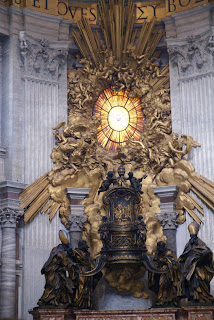


We then took a cab to a square where the Bernini Three Rivers Fountain is located.


This fountain is featured in Angels and Demons. From there we cabbed to the Pantheon and then walked to the Forum.

From the Forum we walked to the Colosseum, jumped on the underground to the central train station, transferred to the train to Civitavecchia and made it back to the ship without incident. I noticed a man in the train station taking down my wanted poster. Wunderbar!
A few comments about Rome. St. Peter’s is magnificent; stunning, really. The Pieta is very moving.Below is a group of nuns viewing the Pieta.


The Sistine Chapel is absolutely breathtaking; the ceiling much higher than I thought. The Vatican Museum is poorly organized and confusing. We spent about an hour looking for the Laocoon, shown below.


The Forum and Pantheon are wonderful.


I kept pinching myself to make sure I was really there. We turned a corner, wondering if we should take a cab to the Colosseum and there it was!


I thought of my Dad, who had a three day rest leave during WWII and spent it in Rome. He had photographs of himself and the Colosseum. All in all, Rome was a wonderful experience.

Wednesday, October 7, 2009

Ex-commie Bureaucracy is Alive and Well


We have spent the last two days in ex-commie pinko countries on the Black Sea. We are currently anchored off Sochi,Russia on a grey, light rain kind of day. Very appropriate in my humble. The closer to Mother Russia we have come, the more bureaucratic things get. In Varna, Bulgaria we had to take our passports with us(first time on this trip) and Bulgarian officials stamped it at passport control as we went ashore in the passenger terminal. Coming back to the ship, they couldn’t have cared less. Varna street market below.

Next stop was Sevastopol, Ukraine. That’s right, that Sebastopol of Crimean War and Charge of the Light Brigade fame. Still a Russian naval base. A boat load of uniformed Ukrainian officials came to the ship and set up housekeeping at the gangway. They stamped passports coming and going, giving us the evil eye in the process. At breakfast this morning a ship’s crewman told us they had jollied them up with breakfast and lunch plus tote bags and decorative Dutch tiles. One of the Ukrainians said “I hope we finish in time for a drink”.Below is an old man messing about in the Black Sea, with the faithful dog waiting patiently.


In Sochi if you wish to go ashore alone, i.e. not on a ship sponsored tour, you had to obtain a Russian visa months in advance at a cost of $100. We declined and also declined any ship sponsored tours. If you chose a tour, you must present your passport to the Russians along with a copy, which they keep. They then give you a landing card which you must take with you along with your passport and return it to the Russians on your return. The Russian officials are also on board and I am sure will be jollied up by the crew. In fact, right now they are being wined and dined in a private room on the ship. They have also detained one of the tour operators and are having trouble getting the buses to the dock. Commie bureaucracy is alive and well.


Why not take a tour of Sochi, you ask? Fine if you want to see “old trees of the Caucasus” or “walking tour of Sochi”. That would be fun—Sochi is 90 miles in length. It is narrow, existing between the sea and the Caucasus Mountains. I hope they get a few things straightened out before they host the Winter Olympics in 2014.

Sunday, October 4, 2009

The Alhambra....with Thanks to Washington Irving

The Alhambra is a combination fortress and palace built at Grenada, Spain by the Moors. The Moors, originally from North Africa, ruled Spain from approximately 800 AD until the last ones were thrown out by Ferdinand and Isabella in 1491 or early 1492. The last remaining Moorish ruler located at the Alhambra cut a deal and left, so the Alhambra was not fought over. Ferdinand and Isabella liked it; it was there that Columbus came to see the Spanish monarchs. One of their grandsons, Carlos the Stupid or something like that had one wing destroyed, but it remained in pretty good shape until being neglected in the 18th and early 19th centuries. Washington Irving visited and actually lived in the Alhambra in 1829. His resultant book, Tales of the Alhambra, aroused interest in the buildings and was largely responsible for preservation efforts that have kept the Alhambra as one of the world’s architectural wonders.

Alhambra means “red fortress”, which is what it looks like from the outside.

The doorways show their Moorish ancestry.


Some windows are shown below.


Blue was used as an accent color as you can see here. The tracery is both rock carving and some sort of stucco process.

Lots of people, including this boy.


The Moors loved water and the sound of it.


This reflecting water feature is in one of the gardens.


This plaque is on the wall of the room Washington Irving lived in at the Alhambra.

It is impossible to show the wonder and beauty of the Alhambra in a few photos. I have many more photos and will try to share them with you later.

Friday, October 2, 2009

Spanish Village....With Apologies to W.Eugene Smith


Mijas is a village in Andalusia 20 or 30 miles outside of Malaga. It is a hill village, several miles up from the shore and hidden from shore by a hill. This was done to prevent pirares from finding and pillaging the village. These villages are part of the Costa del Sol, now a major tourist attraction. Mijas retains a lot of it’s charm; all buildings, including houses, must be painted white. Paint has replaced whitewash. Donkeys and horse drawn conveyances are available for taxis.


The old part of town has narrow curving streets with interesting doors and windows.


There were still some of the older locals about, as you can see.


The market had mostly locals doing their shopping.

The only problem was Mijas was very crowded with touristas.

Thursday, October 1, 2009

"Shut the barn door, I think the horse is out!"


Cadiz is is the Spanish port from which the explorers and adventurers set forth and the port which received the treasure from the Spanish conquests and colonies. Consequently there are several fortifications built around the harbor entrance. One questions how effective they were, since Sir Francis Drake successfully attacked Cadiz and the Spanish fleet in 1587 and a combined English and Dutch fleet sacked the city in 1596. Then they built the forts.

There is a fortified seawall around the old harbor which makes a fine walk with old forts, parks, etc. Cadiz is ancient; there are ruins of a Roman theatre, below.

The photos below are of doors and windows, a street called Pirate’s Alley, a fountain and the remains of an arch in the medieval city wall.


I didn't quite hit vertical on some of these photos(doors,arch). Sorry about that. These are straight from the camera. I have no software on this small computer to do any editing. I will try and do better.