Tuesday, November 27, 2012

Corfu

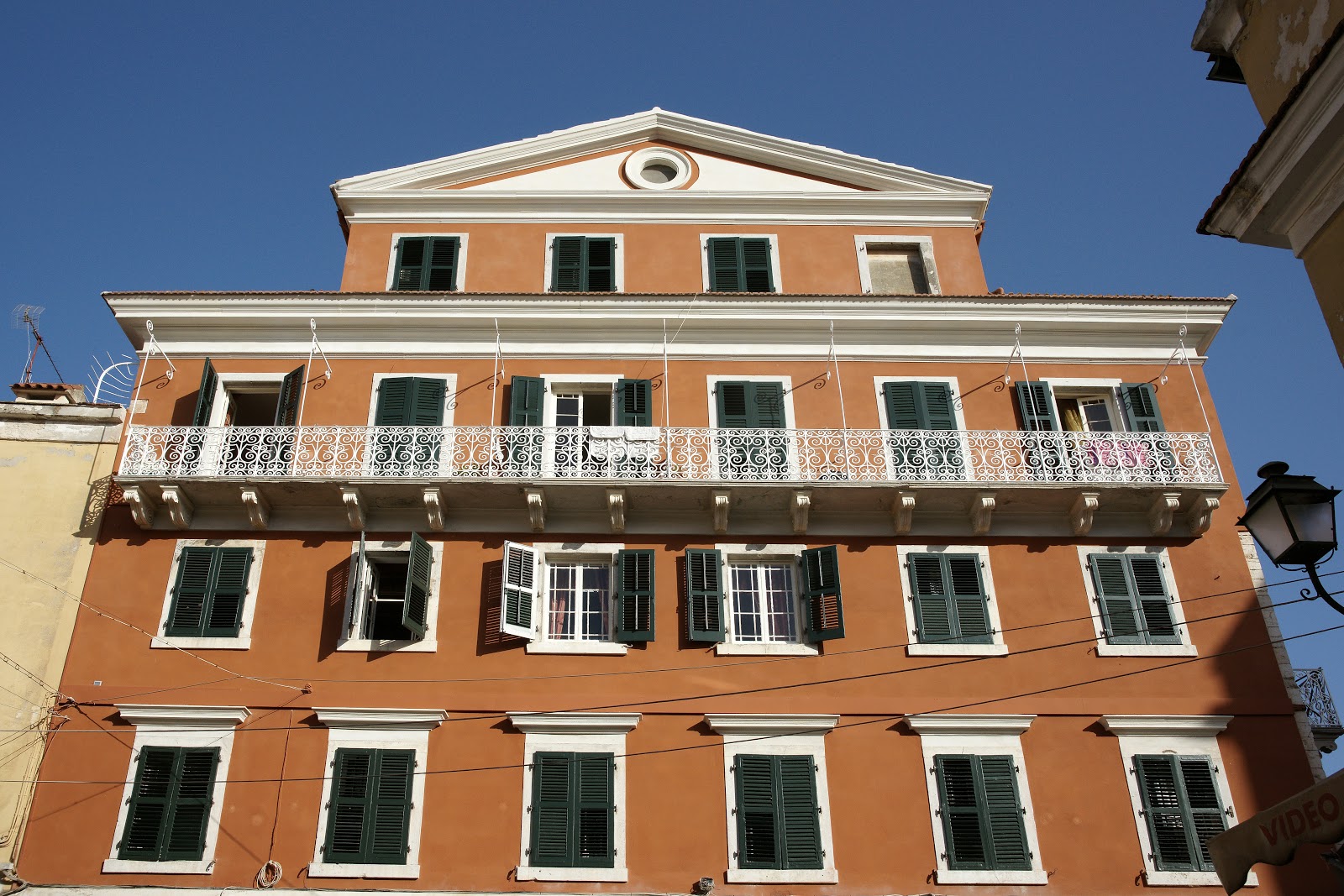
Corfu is a Greek island located in the Ionian Sea off the northwest tip of Greece and a stone's throw across the water from Albania. The main city is also called Corfu and has an old section that has narrow cobbled streets, colorful buildings and shops.It is protected by two castle fortresses, one of which is shown above. Corfu was controlled by Venice for 400+ years and was never conquered by the Turks. The Italians and the Germans occupied it during WWII and the city suffered some bomb damage. It is a favorite vacation spot for northern Europeans and a stop for some cruise ships.

The building above is on a small square. Below are typical streets and shops.


The shop shown below sells olive products. The bottles on the shelves are different varieties of olive oil.


The photos below show a building with close ups of  some of it's windows. 


This door and building have seen better days. Below are photos of another cobble stone street with shops and a door.


I'm not sure what's going on with this fish spa shown below. Maybe the fish are nibbling away on customers' feet or the fish are coming in for a little relaxation. Colorful, anyway.


Below are some more colorful buildings and windows.


Above is another narrow street and the doorway of a shop.


Below is a small square and a bell tower.


Below is a very colorful door.

Below is a narrow street with the bell tower of the Church of St. Spyridon in the background. St Spyridon is the patron saint of Corfu.


Can you guess what kind of shop is shown below?


The Durrell family lived on Corfu from 1935 to 1940. Gerald Durrell  became a naturalist and wrote three books about being a boy on Corfu: My Family and Other Animals, Birds, Beasts and Relatives and The Garden of the Gods.  I can personally vouch for them as great reads. Lawrence, Gerald's older brother and renowned novelist, also wrote about Corfu in Prospero's Cell-a Guide to the Landscape and Manners of the Island of Coryca(Corfu). Enjoy!


Monday, November 19, 2012

Hagia Sophia Redux--Part 2


The above photo shows the upper gallery decor above the Empress' Loge. The upper gallery is reached by means of a long ramp, shown in the photos below. The Ramp starts in the narthex in the orthwest corner of the building.


The first photo below is taken from the upper gallery above the Emperor's entrance looking towards the apse. The second is from the upper gallery, apse end, looking towards the Emperor's entrance.


The three photos above show typical decor of the gallery ceiling, columns and window arches.The photo below shows where some of the Muslim plaster has been removed revealing the original Byzantine beneath. When the Muslims took over in the 15th century they redecorated, including plastering over the mosaics. Their belief does not like depictions of humans but does allow for geometric designs.


The above is a partial bit of a painting or mosaic from an arch in the upper gallery.


This mosaic of Mary with the Christ child is high up in the apse. It has been dated to the 9th century. Below is more of a closeup; at least as close as I could get from the upper gallery.

The mosaics that have been uncovered are quite amazing. The two photos below show what are called the Empress Zoe mosaics. They show Constantine IX, his Empress, Zoe, and Chris or Christ and Mary. They date from the 11th century.


This next mosaic is one of my favorites, even though it is only partially intact. It is referred to as the Deesis mosaic. In the early 1200s the Venetians sacked Constantinople and it was returned to Byzantine control 57 years later. This mosaic was done in 1261 in commemoration of the return to Byzantine control. It shows Mary and John the Baptist with Christ. I find Christ's eyes remarkable; they seem to bore right through me.


The above mosaic, found on the tympanum of one of the exit doors from the nave to the narthex, is another favorite. It shows the Emperor Justinian on the left presenting a model of the Hagia Sophia to Mary and the Christ child. On the right the Emperor Constantine presents a model of the city of Constantinople. This mosaic dates from the 9th or 10th century.

This is a part of the original frieze, depicting the Lamb of God.

A note on the photos--all the photos in this and the previous blog entry were taken with a Sony a900 DSLR and a Zeiss 24-70mm lens. Because of the difficulty of using a tripod here, they were all hand held. The interior shots were mostly if not all shot at ISO 2500, to get the aperture I wanted and have a fast enough shutter speed to prevent blurring.


Thursday, November 15, 2012

Hagia Sophia Redux--Part 1


Hagia Sophia is now a museum in Istanbul, although originally built as a Christian church in 527 AD by the Byzantine Emperor Justinian. It was converted to a mosque when the Muslim Turks conquered Constantinople in the 15th century. It was opened to the public as a museum in 1935. The photo above shows the Hagia Sophia at sunrise from the Golden Horn; it is the large building to the left of center. Below is a closer view.


This was the largest dome in the world until a cathedral in Seville and St. Peter's in Rome were built in the 16th century AD. The Statue of Liberty will fit inside the dome as will Paris' Notre Dame Cathedral.


These flying buttresses were added several centuries after initial construction to add strength.


The mosaic shown here is over the door from the narthex into the nave. This was the door by which the Emperor entered; no one else was allowed to use it. The mosaic is from the 9th or 10th century and shows the emperor prostrating himself to Jesus Christ.


Above is a huge door; the doorway is between the narthex and the nave. Below is the threshold, showing the results of 1500 years of foot traffic.


We arrived about five minutes after the opening, 0900. Lights were still on in the interior and there were relatively few people inside. It was quiet inside and the quietude added greatly to the experience. You could almost feel the presence of the thousands upon thousands of people who had worshiped here over the centuries. The immenseness of the space and the fact that it was built in the 6th century also added to the awe of the place.

Below is a photo of the interior looking towards the apse. On the left is the Empress' box in which she attended services; it was entered from the gallery. The apse is in the middle with a mosaic of Mary and Jesus high up on the back wall. The large round medallions with what appears to be Arabic writing were added by the Muslims.


The photo above is taken from near the apse looking diagonally towards towards the Emperor's entrance. Below are shown  two of the massive pillars supporting the dome.


This is a massive marble jar brought from Pergamon.


 Above is the Empress' box. She and her retinue of ladies would attend services in this box.

Below is the dome, photographed from the main floor looking straight up. The last photo is of one of the six winged seraphim or cherubim, I'm not sure which is correct, which are found on the supports of the dome.


I first visited Hagia Sophia in 2009 and wrote about it in a blog entry of Oct 19, 2009. I will write more about it in the next blog entry, Hagia Sophia Redux--Part 2.


Monday, November 12, 2012

Two Vets


 This is a tale of two U.S. Army veterans--My father and I. My father served in World War II;  he was in combat from the D-day landings in North Africa until he ended the war in Germany(See post of June 19, 2009). I was on active duty from July 1 1964 until June 30 1966--Vietnam. More about that later.

My father and I were separated from the time I was three years old until I was six. As you can imagine I thought he walked on water. I wanted to do what he did, wear what he wore, etc. He brought some things home with him that he used during the war, a few of which I still have. One of the things that came home with him was a musette bag, shown here. This is not the one he brought home, but a photo of one exactly like it.


When I got old enough to go on hikes, join the Boy Scouts, etc Dad's musette bag became my back pack. It was a lousy back pack, but that didn't matter. If my Dad used it, it must be great!

In North Africa while waiting for the invasion of Sicily he bought a pair of British combat boots at a PX the Brits had set up in Bizerte. They were great boots--very nice leather, lined with glove leather and very well made. Dad's foot was about 1/2 to 3/4 size bigger than mine as an adult, but I didn't care. They were HIS, and so as soon as I could reasonably wear them I did. I don't remember now if I stuffed paper in the toes or just slopped around. In the photo below he is on the left in these combat boots, in France after the war has ended.

They were not GI issue, but after you've been in combat awhile nobody argues with you unless you get completely ridiculous.


While he was in Sicily  waiting to go to Italy he had an Italian leather worker make him this holster for his 45. For some reason or other he didn't like the GI issue one. He brought the holster home, but did not bring his 45. I have the holster and the weapon in it is a government issue 1911 45, manufactured by Colt. It was worn high, sort of like a shoulder holster. He is wearing it in the photo below; he is the one on the right.


Also he has a pair of Bausch & Lomb binoculars slung over his shoulder. They also came home; I still have them. They are shown in the photo below with their case.


Above is yours truly camped on Mt Lemmon at about age 14. To my left is a sleeping bag, spread over some logs or something. You are correct. This was Dad's sleeping bag that he used for the duration of the war and brought home. I used it for years. It wasn't that good a sleeping bag but hey! it was his. Plenty good enough for me. It went to it's rest years ago.

He also brought back a collapsible canvas bucket, shown below, which I still have.


This next photo shows it in action on the above camping trip.


 This is me during college days at the University of Arizona. I was in ROTC and was part of some sort of honor guard when this photo was taken. I went to medical school after three years of  college and was given a direct commission as a 2nd Lt in the Medical Service Corps. At the end of my internship, after 4 1/2 years of active reserve, I was ordered to active duty for two years. I was stationed at Sandia Base(Albuquerque), Ft Bliss and Arlington Heights, Ill. where I ended my military career as the commanding officer of a small dispensary. For some reason or another I can find no photos of me on active duty.

This was the time when Lyndon Boob decided he needed a war(1965). I was ordered to Ft Bliss to join the 85th Evacuation Hospital which was the first Evac hospital sent to Vietnam. It turned out I had bilateral retinal hemorrhages and was pulled out of the 85th and sent to Arlington Heights.For years I felt guilty for not going; I felt that I let my father down because I didn't go. At the time he said he was glad I didn't go, but he didn't really say much about it. A few years before he died he volunteered that he was so glad that I had not gone to Vietnam. He thought it a stupid, useless war not worth the price of a single American.

Thanks, Dad. And thanks to all the other vets for your service.