Saturday, February 9, 2013

Ephesus II

The ancient city of Ephesus is located in western Turkey, near the port of Kusadasi. At it's height in the 2nd or 3rd century AD it had some 250,000 or more people. It was one of the most important cities in the Roman Empire. The Apostle Paul spent at least two years there and wrote letters to the Christian inhabitants. Ephesus was a port and when the port silted up it ceased to have any importance and basically withered and died.

On this trip to Ephesus we hired a private guide. Four of us tourists, one guide and one driver in an air conditioned Mercedes van, plus lunch The guide spoke excellent English and was very knowledgeable. The name of the tour group is Magical Steps and can be found at www. magical-steps.com. Highly recommended. I previously wrote about Ephesus in a blog called, strangely enough, Ephesus, on 10/13/09.

On entering Ephesus you proceed down a long street which was a main commercial street. Shops, a small theatre, a Roman bath, temples and a small Christian Basilica are found along this street. Near the bottom of the street the hills rising to the south have been excavated extensively, revealing what are called Terrace Houses.These were private houses, with some common areas. They were for the well off, sort of like Scottsdale or Beverly Hills condos.


The photo above is some of the ruins on the north side of the street. Below are what appear to be bulls' heads decorating the tops of some columns.


Below is a water pipe. Ephesus had both running water and a sewer system. The sewage was collected and used as fertilizer, according to our guide.

 Below is an early Christian basilica. Note the cross on the lintel.

 Below is a small theatre.


The two photos below reveal some of the construction methods. Interlocking pegs and holes were used. Many of the columns were made of small drums fitted together with the same type of peg and hole technique. Sort of like a giant Lego set.


In the photo below are some bas-relief sculptures, perhaps part of a temple.


The two photos below are two of my favorites, because I can relate to the occupants. The top one is the sign of a physician, the staff of Aesculapius, and the bottom one, which was located directly across the street, the sign of a pharmacist.


 Pictured below is a small temple.


Details from a building, probably a small temple.

Below is a photo of a lavatory. I know I showed this in the earlier blog about Ephesus(10/13/09),
but I need to make some corrections. It was a men's lavatory, not women's, and was part of the Roman bath, which was also men only.


The next series of photos are all from the Terrace Houses. The first shows wall plaster and painted decoration from a Terrace House room.


This next photo is of the small Christian basilica in the middle of the Terrace Houses.


 The photo below shows some walls partially restored. Much of this work is like trying to assemble a gigantic jigsaw puzzle.


This photo shows partially restored exquisite wall paintings.


The photo below below shows excavation and restoration in progress. Note the extensive floor mosaic .


The owner of the house below seemed to like birds.


A broader view of some of the restoration.


This lion is a wonderful floor mosaic.


Another broader view.
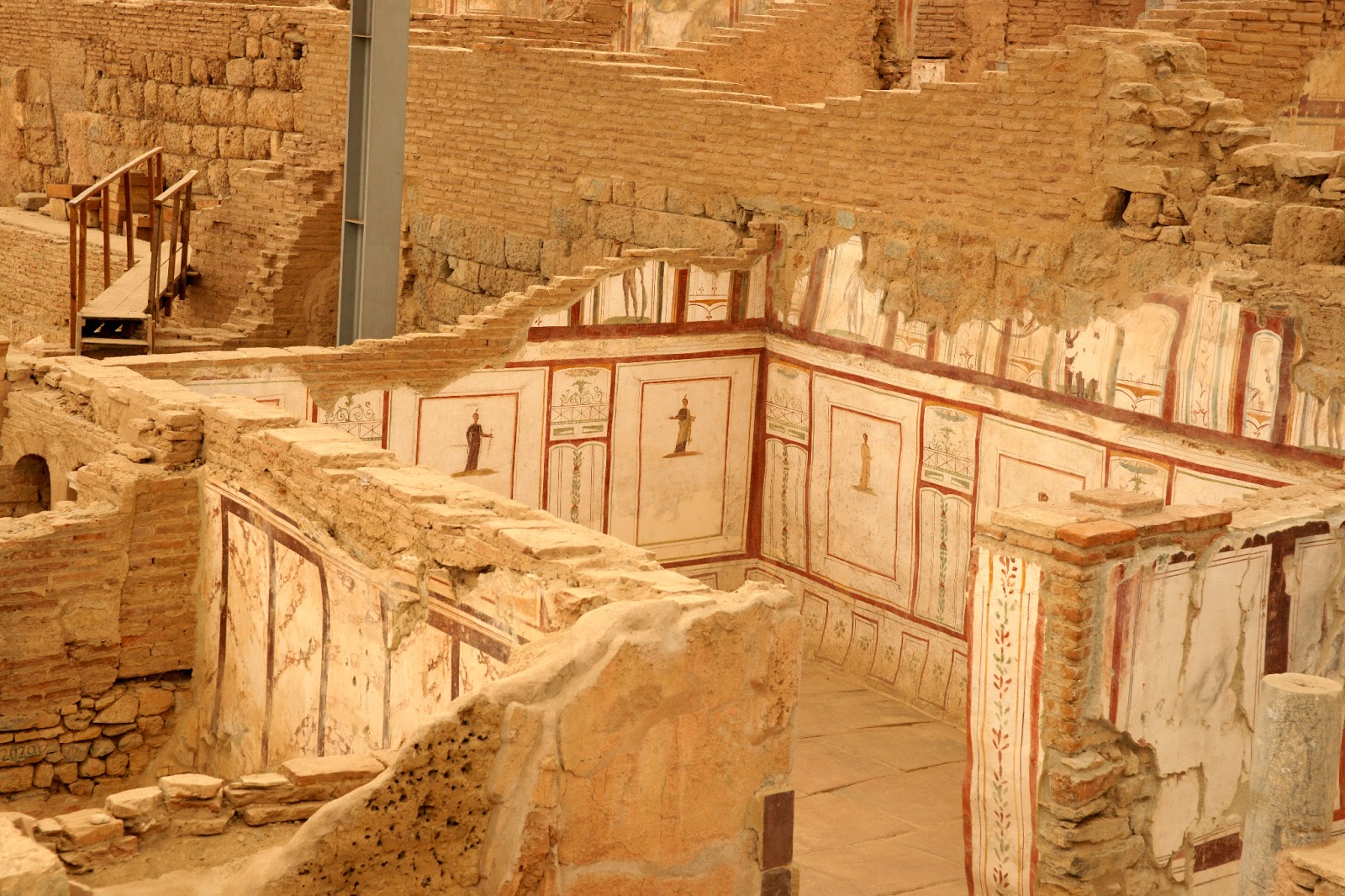

A floor mosaic of a woman, along with some wall paintings.


Again a view of several rooms and walls.


Painting of what appears to be a dove or pigeon with a flower in its mouth. Note the water pipe showing on the right.


Another great floor mosaic.


Below is a view of west Ephesus from the Terrace Houses. This area is choc-a-bloc with unexcavated ruins. Only about 20% of Ephesus has been excavated.


 This is the Celsus Library, second only to the library at Alexandria. It is located just west of the Terrace Houses at the bottom of the main commercial street.


Another street with many columns still standing.


 The street below is the main street leading down to the docks.


Another side street.


 Below is a young woman weaving a silk Turkish rug. This was at a government run facility for the encouragement of traditional Turkish arts and crafts. It was very interesting and without any pressure to buy.


Below are some of the ruins of the temple of Artemis, at one time a magnificent place. Very close to the excavated ruins of Ephesus.


I highly recommend Ephesus, and I highly recommend doing it with a good private guide, such as we did this time.

Saturday, February 2, 2013

Kotor, Monte Negro Part II

The blog on Kotor was getting too long so I decided to break it into two parts. The photo below is of an old gate in a wall.


The next photo is a sort of National Geographic moment. The red T-shirt kind of pops out.


The photo below is of a door that I quite liked. I don't know what it leads to.


The next photo is of a small square. Note the green shutters and the lady in a red top with her dog.


The three photos below show the defensive sea wall and some of the wall going up the mountain to protect the town from raiders coming over the mountain and down to the town.


The next photo looks up the mountain from the seawall. You can see some of the wall going up the mountain, fortifications and a church.


Above is a flower growing out of a crack. I thought at first that it was artificial , but on closer examination I think it is a real flower. Below is another great door.


The two photos below show two different sets of stairs on narrow streets leading to two different businesses.


The corner shown below is interesting with the rounded building on one side and the square on the other, with green shutters, of course.


I think this church is the Cathedral of St. Tryphon.


This dog seems to be enjoying himself on the veranda. Why not?


I just about fell down laughing when I came to this down a narrow side street. I presume that every international society of neurologists and/or  neurosurgeons must hold their meetings at the Hotel Hippocampus. The perfect place for such meetings.


Unfortunately its time to say farewell to Kotor. The photo below shows the town of Kotor and the mountain behind from the ship.


This next photo is of a village partway down the inlet towards the Adriatic.


The island on the left in the photo below is a man-made island. Rocks, old ships, etc. were put there to create the island and then a church built on it. The church is Our Lady of the Rocks.


The sun sets as we approach the Adriatic Sea. Farewell to Kotor--a great experience.


Friday, February 1, 2013

Kotor, Monte Negro

Monte Negro is a small country on the east side of the Adriatic Sea. It is bordered by Croatia, Albania,Bosnia, Herzogovina, Kosovo and Serbia. Kotor is a small port city, population about 14,000, located at the foot of the mountains at the end of a long inlet. It took at least an hour to get by ship from the mouth of the inlet on the Adriatic to Kotor. The inlet looks very much like a fjord, but according to the geologists it is not a fjord but a flooded river valley. Oh, well...it looks like a fjord, it quacks like a fjord...


 In the photo above we are just entering the inlet from the Adriatic. The photo below shows a commercial mussel farm up the inlet a little ways.


The photo below shows a church halfway up the mountain.


Below is a village and two churches.


Kotor owed allegiance to, and received protection from, Venice from 1420 to 1797. The sea wall above and the city wall shown below are both Venetian. Note the Lion of Venice. For much of this time period the Adriatic Sea was a Venetian lake.


This deep green color shown on the shutters  in the two photos below is typical of Kotor.


Kotor is basically a medieval town, with very narrow streets and some small squares. A typical street is shown above.


The photo above shows a typical street lamp, the ubiquitous red tile roofs and the domes of a church with the rugged mountains rising in the back ground. Because of the abrupt rise of the mountains from the sea there is very little room for a town.


Above are a gate and a door. I believe the door is a side door to a church. I don't know where the gate leads.


I believe this is the Cathedral of St. Tryphon, shown from a side street.


This dog was minding its own business on a small square when a tourist took its photo. A gypsy woman immediately claimed the dog was hers and demanded money for its photo. Of course the dog was not hers and she was quickly sent packing. We had several encounters with gypsies, but only the one in Kotor.


Small square. I believe the church is Serbian Orthodox, but I am not sure.

Small dress shop off a square.


 I like the above building. I think it has a lot of character. Note the dark green shutters.


I think this is a tower on a church. Note the flower growing out of a crack and the rugged mountains behind.


This is a water fountain on one of the squares--apparently no longer used.


Above-- note the flowers growing out of the cracks in the wall.


A typical narrow medieval street. Note the green shutters and the wash hanging from the third story windows.