Saturday, November 21, 2015

Volklinger Iron Works


Volklinger is a small city along the Saar River in Saarland, Germany. It is about 10 miles west of the center of Saarbrucken. This area was rich in coal and iron ore deposits. As a result coal and iron mines were established here along the Saar River. The The Volklinger iron works were established in 1873 and were in continuous operation from about 1880 until 1986. The town of Volklinger grew up due to employment in the iron works and the mines. The height of employment for the iron works was 17,000 in 1976. The iron works closed in 1986 and it has been preserved as a Wold Heritage Cultural site. I believe it is the only iron works plant from the 19th and 20th century still intact in North America and Europe. The plaque below shows some of the information about it.


The plant is about 14 acres in size. You can take a self-guided tour if you wish. We did not due to time constraints. Below is a view of one side of the works from the parking lot.

The photos below are presented without comment because I don't know the particulars of what we are looking at.


The buildings below were warehouses to hold finished product, mostly pig iron.


The World War II history of the Volklinger iron works is very curious. During the war there were at least 26 air raids by the Royal Air Force and the US Army Air Force aimed at Saarbrucken. Most of the city of Saarbrucken was leveled with many civilians killed and many thousands left homeless. The Volklinger works produced more pig iron than any other plant in Germany and yet not one single bomb fell on it. There are photos from the end of WWII taken by a US GI that show smoke rising from the stacks(http://lostimagesofww2.com/photos/places/saar.php). It is not possible that the allies didn't know of its existence. Strategic bombing was supposed to reduce the German war production. Much of it, however seems to have been vengeance bombing on the populace. Granted, high altitude bombing at that time was not terribly accurate at best but it seems to me that missing a target of this size for three years means that it was off limits for some reason or other. The air force records of the war have been reviewed by others and there is no explanation in them. There are, of course, conspiracy theories but nothing I know of to support them.

During WWII 14,000 slave laborers manned the iron works. An additional 10,000 were used as miners in the mines in the immediate area.

In addition to touring the plant art installations and other cultural events are held on the grounds.
A very interesting place to visit.


Saturday, October 31, 2015

Aachen Cathedral--Charlemange's Church

Aachen is a city in northwest Germany on the border with Belgium. It was the capital city of the Holy Roman Empire under Charlemagne. Charlemagne built a palace there with a chapel attached. The palace is gone but the chapel is still there; over the centuries it has been added to and is now known as Aachen Cathedral. The chapel was dedicated by Pope Leo III in 805 AD.

The architect of Charlemagne's church was a man named Odo of Metz. He was inspired by Byzantine architecture and modeled this church after a church in Ravenna and the Hagia Sophia and Little Hagia Sophia in Istanbul. This church is octagonal in design with an octagonal dome-cupola. There have been additions over the centuries of towers, a choir and additional chapels. Below is an exterior photo of the current cathedral. You can see the octagonal structure of the original palatine chapel in the center.


The photo below shows the entrance to Aachen Cathedral. The doors in the center at street level are knows as the Wolf's Doors. They were cast of bronze in Aachen in about 800 AD. The next two photos are closeups of these doors, including the Lion's Head handles. The doors weigh about 4 tons.


This is the main floor of the chapel looking towards the choir, which was a later addition.


The chandelier seen in the above photo and in the photo below was given to the cathedral by the Emperor Frederick Barbarossa and his wife, Beatrice, around 1165 AD. It still utilizes candles and is lit only on special occasions. It takes most of a day for a crew to put in new candles.


Charlemagne's throne is located in the gallery above the main floor. It is marble; some of the stones under the throne on the platform came from Jerusalem. It looks plenty uncomfortable but I guess if you covered it with furs, silks, pillows, etc. I suppose it would be okay. It is shown in the two photos below. Between 936 and 1531 AD 30 German kings and 12 German queens were crowned here using this throne.


On his death in 814 AD Charlemagne was buried in the chapel. In 1165 AD Frederick Barbarossa had Charlemagne's remains put in a gold box, which is on the gallery floor near the throne. Carlemagne was also canonized in 1165 AD. This box is shown below.


The photo below shows the bone box from the end. Frederick Barbarossa made a political statement with this end. Charlemagne is shown as the middle figure with Christ above him. There is a church official on either side of Charlemagne with their heads bowed.

The photo below is taken from the gallery near the throne and shows the main floor and the Frederick Barbarossa chandelier.


Below is the mosaic on the dome of the cupola, seen from the gallery near the throne.


We had a little friend with us who managed to get an Aachener Dom cookie, available only in Aachen. She managed to keep it away from the cow, and sat in a throne on the square.


When we returned to Saarbrucken Little Bit decided she could make a better throne than the one Charlemagne had. It is shown below.


Monday, October 26, 2015

Metlach, Gemany

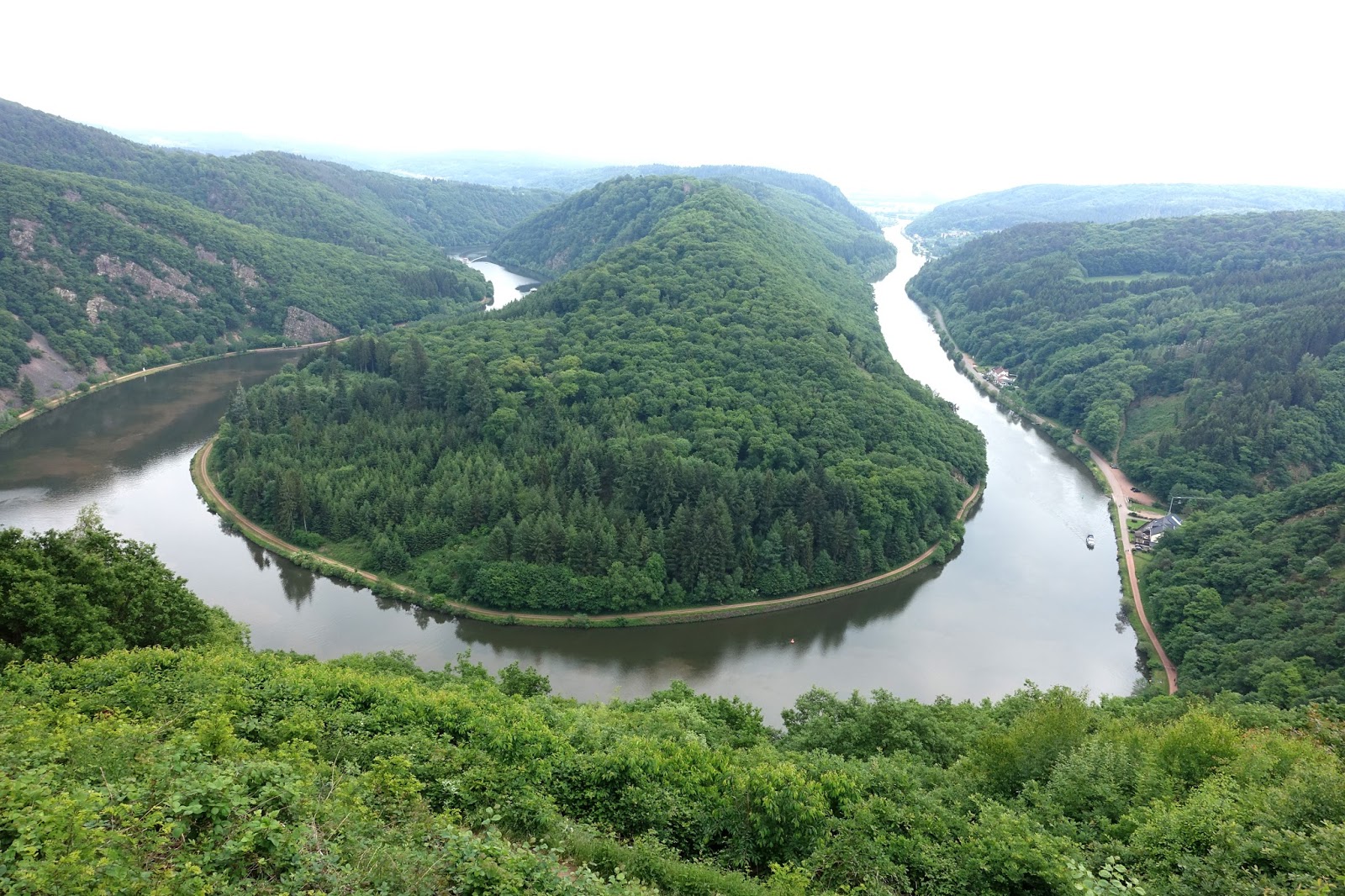
Metlach is a small city of about 12,000 located on the Saar River in Saarland, Germany. It is about a one to two hour drive northwest of Saarbrucken and about 30 kilometers south of Trier. Metlach is just south of a hairpin bend in the Saar River. It is the home of several outlet stores, including Birkenstock. It is also the home of Villeroy and Bosch, a major manufacturer of porcelain products. It is a fun day or half day trip from Saarbrucken.

Below are two houses along the Saar in Metlach.


The photo below shows some shops and a gasthaus on the main street in Metlach.


The photo below shows an old tower like building from about 989 AD. It is modeled after Charlemagne's Palatine Chapel in Aachen and is the oldest religious building in Saarland.


These geese were out for a stroll in the park.


This next photo is from the Villeroy and Bosch museum.


Below are two photos from the Birkenstock outlet store. I think someone is getting a new pair of Birks.


This is the horseshoe bend of the Saar River.


Let's go for a walk.


Saturday, October 17, 2015

St Stephen's Cathedral, Metz, France

Metz, France is a city in eastern France on the Moselle river, about 60 miles due west of Saarbrucken, Germany. St Stephen's Cathedral, commonly known as Metz Cathedral is located there.

Metz Cathedral is made of local yellow Jaumont limestone. Its nave is one of the highest in the world, at 135.9 feet. It has the largest expanse of stained glass in the world, 69,920 square feet. The photo below is a view of the cathedral showing the south-east side.


The cathedral was begun in 1220 and not completed until 1520, with dedication in 1522. The photos below show some of the decorative sculptures on the exterior.


The photo below is of one of the portals. I believe Christ is on the center post.


The portal shown below is the portal through which you enter the cathedral. The center post has Mary holding the infant Christ.


This is what you see on entering the nave.

The side aisles are relatively low compared to the height of the nave, which allows the clerestory to be quite large and filled with stained glass windows, as shown below.


The stained glass dates from the 13th century through and including the 20th century. There is one remaining 13th century window which I do not have a photo of. The west rose window, shown below, is from the 14th century and done by a man named Herman Munster.


The two photos below are of the two transcept windows.


The window below is 20th century by Jacques Villon.


The next window is also 20th century by Marc Chagall.


I do not know who did the windows shown in the two photos below nor do I know their age.


The last three photos are along the Moselle just a couple of blocks from the cathedral.