Showing posts with label Arizona. Show all posts

Friday, December 19, 2014

Coal Canyon or Coal Mine Canyon, Arizona

Coal Canyon or Coal Mine Canyon, Arizona is a canyon southeast of Tuba City on the Navajo Reservation. Some friends from Tuba City took me out there one day. They referred to it as Coal Canyon, which is what I have always called it until I looked it up on the internet, and found Coal Mine Canyon. It's the same place.

Coal Canyon is located about 15 miles southeast from Tuba City on Az Highway 264. The canyon is on the northeast side of the highway. The turnoff is unmarked. It is a beautiful little canyon, much like Bryce only smaller with streaks of black coal here and there, hence the name. The photos were all taken on 35mm film, I'm not sure what brand. They were then scanned on a plustek 35mm film scanner. The photos were all taken on one winter afternoon in 1991. They were all shot looking north.


This area has an enormous amount of color and shapes in a rather small area. Hope you enjoyed the photos.

Monday, April 14, 2014

April in the Arizona-Sonoran Desert

April in the Arizona-Sonora desert is usually a wonderful time. Daytime highs are in the 80's and 90's, with the nights cool and pleasant. This is also when the desert really starts blooming. Wild flowers, trees and cacti all get into the act. What follows are some photos of this spring flowering taken in April 2013 and April 2014.

The first series of photos, five in all, focus on brittle bush. Brittle bush is a common small shrub of the Arizona-Sonoran desert. It is called brittle bush because it's woody stems are brittle. There is always brittle bush blooming in the spring; some years much more plentiful than others, depending on rain fall. These photos of brittle bush are all from April 2013, off the Four Peaks road north of Phoenix. 


 In the photo below is a barrel cactus with green palo verde trees in the background, which have not yet put out their yellow blossoms. I believe the small orange flower is a globe mallow.


The next three photos are of ocotillo. Ocotillo is a woody plant with long slender branches reaching up from the ground. They have an orange blossom on them in April. If you cut one of the branches off and bury the cut end in the ground it will grow. In southern Arizona it was common to do this,  weaving the ocotillo with wire fence, creating a living fence. Very good for a small corral. An added bonus is that the ocotillo has very sharp thorns. In my experience they tend to grow on rocky hillsides, sometimes in thickets. A helluva place to have to get a cow out of.


The next two photos are of palo verde trees. They are called palo verde because they have green bark. They cover themselves with yellow blossoms in April. One of my favorite trees. These two photos were taken this April in a wash on the Florence-Kelvin “highway”. The small orange blossoms in front of one of the palo verdes is globe mallow, I think.


The last photo is of a hedgehog cactus in bloom, taken off the Four Peaks road. The hedgehog grows close to the ground and has this beautiful blossom. A favorite cactus  of mine. 


Saturday, February 1, 2014

Pinal Pioneer Graveyard Revisited

It's beem almost three years since I last visited the Pinal Pioneer Graveyard(see post Pinal Pioneer Graveyard dated 5/17/2011). This graveyard is about one mile west of Superior, Arizona, just west of the remains of Pinal, Arizona. It ceased to be an active cemetery when a new cemetery was created in 1916. The World's Oldest Photographer(WOP) was indisposed but I was able to gather the Old White Haired guy(OWH) and make a visit about a week ago.

The biggest change is the fence that now encloses the cemetery on all sides. It is a sturdy barbed wire fence with a maze like gate located at the east end. This keeps vehicles and cattle out but allows human foot traffic. A sign has also been erected just inside the gate explaining the cemetery. The two photos below show the fence, gate and sign.


Picket Post Mountain is seen in the background and in the photo below.


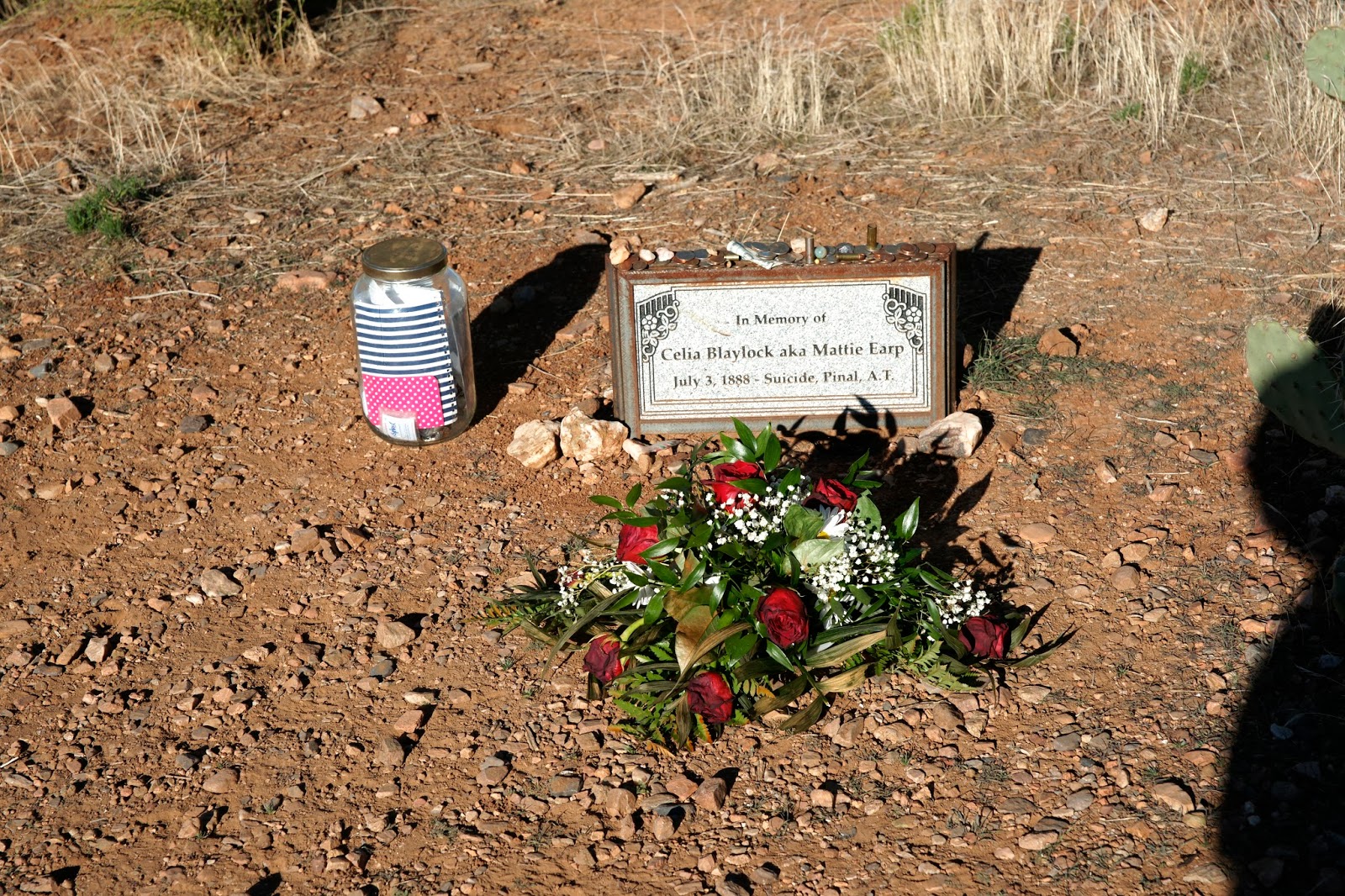
We had to walk about 1/4 mile past the gate before we came to the graves. I had seen on the internet that someone had placed a memorial marker for "Mattie" Blaylock Earp, Wyatt Earp's common law wife who died near here of an overdose of laudanum in 1888. It is not known exactly where in the cemetery her grave is, so this is a memorial rather than a grave marker. The memorial is shown below.


The grave shown below is still quite well demarcated by rocks and a wooden cross.


The grave below is poorly demarcated but the remnants of a wooden cross are still present.


Below is a grave outlined nicely with rocks. A cholla cactus seems to be acting as a head marker.


The grve below has what I presume was the headstone flat on top of the grave now.


The photo below shows two of my favorites; you can see the proximity to each other. I have no idea if they are related. This photo is looking almost due west.


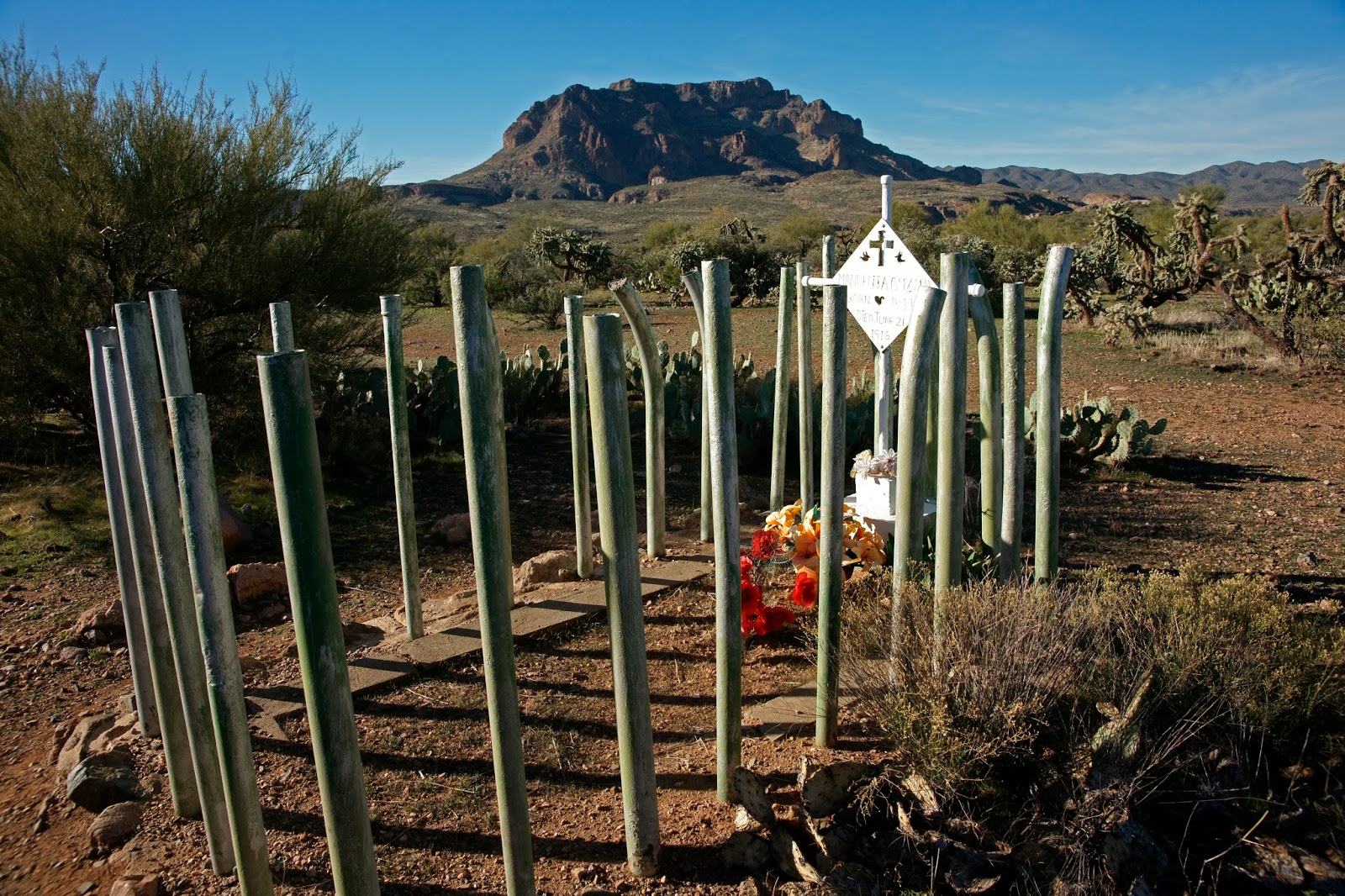
The photos below are of these two graves individually. In the background of the one surrounded with pipes is Picket Post Mountain.


Manuelita Guzman is buried in the grave surrounded by the pipes; her marker is shown below.


The photo below shows a group of at least four graves; one has a stone marker, two are well outlined by stones, one has a wooden cross laying on the ground inside the stones, one has an upright cross, and one is marked only by a wooden upright post with a red rose on top of it.


The next photos show these graves closer up.


The grave below still has a stone marker.


The graves shown below are a family group; at least three children from the Harkey family are buried here. They didn't die at the same time but over a few years; one about age 11 as I remember, one after birth and one at age one.  For me these graves are very poignant. Someone has placed small toys on the middle one.


This is a good place to visit to get a somewhat sobering look at the not too distant past.

Monday, November 11, 2013

Veteran's Day and a Little Bit of England


At the beginning of World War II the Brits were running short of fuel, training aircraft, pilots, and airfields on which to train new pilots. They did have an abundance of lousy weather, which was not helpful for pilot training. Churchill asked Roosevelt if the United States could help by providing training fields, fuel and aircraft on which to train pilots. Roosevelt agreed and as a result six fields were established in the United States, called British Flying Training Schools(BFTS). BFTS No. 4 was built east of Mesa, Arizona and called Falcon Field, at the Brits request. The first cadets reported in September 1941. BTFS No. 4 operated until the end of the war in 1945. Some 2500 cadets went through flight training at Falcon Field. Of this number 23 were killed in training accidents and are buried in  a small section of the Mesa Cemetery. Six Americans also died during this time.

Every year a memorial ceremony is held at this site on the Sunday before Veteran's Day. We have attended several and always found them very moving Yesterday was no exception.

The photo below shows the area where the Brits are buried with the wreaths in place. This section is maintained extremely well.


This monument is at the south end of the section, next to the road. The names of the 23 cadets are on  a plaque on one side of the stone.

The Mesa Caledonian Pipe Band marched down the road before the start and took their place just east of the section, as shown below.


 There were several speakers but my favorite was the man shown below, a British cadet who attended BTFS No. 4.


There were several flyovers of vintage aircraft. The first photo below is of Stearman PT-17 biplanes in which the cadets at Falcon Field trained. The second photo is of  North American Aviation AT-6s, also used by cadets at Falcon Field. One of these groups flew over in the "missing man' formation.


I do not know what the aircraft are in the next two photos.


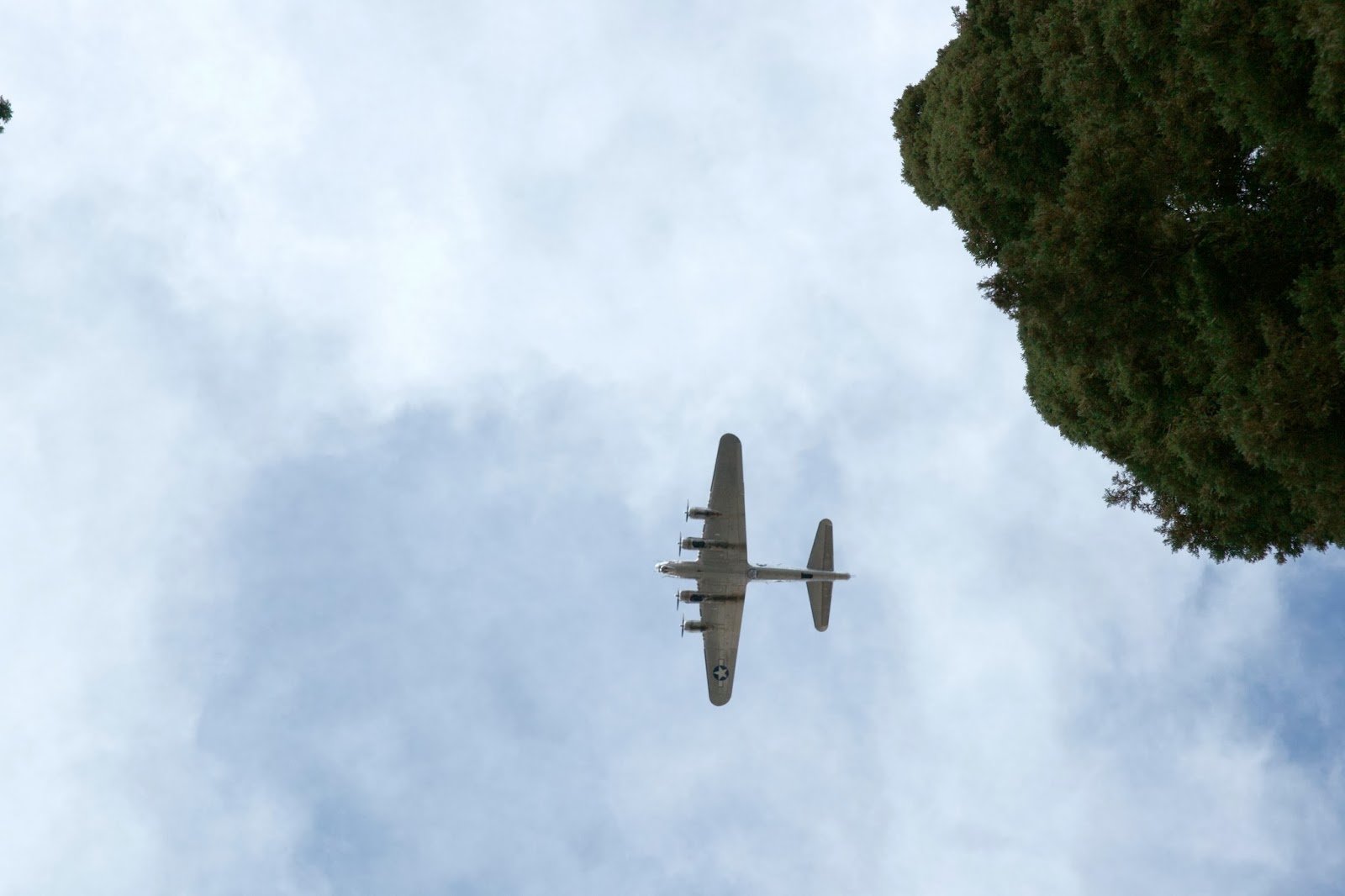
The first photo below is of a B-17  and the second photo shows a B-25. The Commemorative Air Force, based at Falcon Field is now the sponsor of this memorial event and supplied the aircraft, pilots and the flyovers.


 There were a number of wreaths placed during the memorial. The first photo below shows the wreath of Her Majesty's Government being placed by a Royal Navy Officer and a member of the British Consulate's office from Los Angeles, followed by a closeup of the wreath after placement.


The photo below shows the wreath of the Daughters of the British Empire, Arizona Chapter, being placed.


I am not sure to whom the wreath in the first photo below belongs. The wreath in the second photo is from Active Duty RAF Personnel, and is being placed by an RAF officer.


The laying of the wreaths was followed by a 21 gun salute by an American Legion squad, shown in the first photo below, and then by a bugler playing the British Tatoo(Last Post) followed by Taps, shown in the second photo below. I did okay until Taps; in a setting like this Taps always makes me teary eyed.


Following a benediction, the colors were retired, shown below.


We went back to the cemetery today and looked more closely at the inscriptions on the individual head stones. This one really got to me. Their only son killed and buried 5000+ miles from home.


We also visited my Father and Mother's graves, not far from this section in the same cemetery. Somehow it's fitting that as allies they should be buried nearby.