Thursday, April 7, 2011

Cowboys--Real Narrow Between the Eyes


After long and careful consideration, much cogitation and deliberation I have come to the conclusion that us cowboys ain't the brightest bulbs in the string. We're not real stupid, just sort of dumb. A few examples follow.

I was helping a friend of mine with cattle on a ranch he leased in southern Arizona. I had horses, and for helping I got to run a few head of my own cattle on the place. It was called Brown Canyon Ranch and the west end of the canyon ended in Baboquivari mountain, which is a sacred mountain to the Tono Odham, (previously known as Papago). This area is slightly higher than Tucson.
The two photos below show the working corrals at Brown Canyon with Baboquivari, the distinctive shaped mountain in the middle, and my little herd. I was well on my way to becoming a cattle baron.


My friend was an old Montana cowboy named Kip Ripley who had moved to Arizona for the health of one of his children. He was in ranch realty which was how he came on to this place. Not long after he started the lease he called me and said he was going to turn some cows onto the ranch but needed to ride fence first and could I help. I said sure and so we agreed to do it that weekend. This was about the first of January. On the appointed day I loaded up a couple of horses and drove down there. This was all well and good but it turned out to be the coldest day of the year with a light snow falling and a wind blowing. I wore a sheep skin coat, chaps, gloves and whatever else I could pile on. I saddled two horses, riding one and leading the other by a halter rope which I held in my hand, the rope not wrapped around my saddle horn. It all seemed like a good idea at the time. That was before the horse I was leading stopped, unknown to me, and the resulting jerk pulled my arm backwards and tore the rotator cuff. Why I was leading that horse is a mystery to me now. He was saddled but wasn't carrying things like wire or fence posts. Dumb.

The photo below shows typical Brown Canyon Ranch country and the very fence I was riding.


When we were living in Sierra Vista I had another friend who had some cattle but no horses. He called me up one day and asked if I could help him check on his cattle and the fence. Being a slow learner I said sure. This was in early December. The area where the cows were was in the foothills of the Huachuca mountains, probably about 5000 feet high. He said how about this Saturday? I said fine and he said this would also get us out of having to go to the Christmas parade. On the appointed day the inevitable happened—cold, wind, sleet and snow. Turned out to be the coldest day of the year. Although there were no injuries we paid a substantial price for missing the Christmas parade.

One day towards the end of June Kip calls me and says we need to brand. Now Kip liked to let the calves get pretty big before he worked them. They were usually yearlings before they were branded, ear tagged, vaccinated and cut(castrated for the uninitiated). He didn't usually sell them until they were about two year olds. Me: “When do you want to do this?” Kip: “ How about the 4th of July?”Me: “Say what? That'll be the hottest day of the year!” Kip: “Gotta be done.” Me: “Okay. See you there.”
The photo below shows typical Brown Canyon ranch country with some of our cattle.


True to form, I'm sure it was the hottest day of the year. I think where we were(Brown Canyon) it was about 105. Compared to Phoenix at 110+ I guess it wasn't too bad. However we built a nice fire to get the branding irons hot, handled wood, fire, hot irons, hot cattle etc. most of the day. We used a branding chute so didn't have to rope and wrestle with the cattle but it was still about as hot as I ever want to be. I have no idea how much water, cold drinks, etc. we went through.

Irons in the fire.


One time we ran onto about a two year old bull that had somehow missed being branded, cut, etc. Since we didn't want him breeding, we managed to herd him into a corral. This corral had no branding chute, but did have a stout pole, sort of like a short telephone pole, in the middle. So we roped the bull, one on the head and one on the heels, and stretched him out on the ground. This is how you brand out on the range where there are no corrals or branding chutes. We snubbed the head rope to the pole. We branded him, ear tagged him, and cut him. This did not endear us to him. In this situation when you are finished you want the head rope to come off before the heel rope. However, this critter slipped the heel rope first and was standing upright pulling back on the head rope still snubbed to the post. We can't just unsnub him and let him go with the rope still around his neck because he might get hung up in brush, trees, cactus, etc. on the range and die a miserable death. Kip being 20 years older than me, I am elected to get this rope off this ex-bull. So I take a knife, get in position to cut the rope around his neck, which puts the ex-bull arm's length from me staring straight at me. I'm hoping that because he is pulling back on the rope he will go backwards when I cut the rope. No such luck. The rope is cut, he runs straight at me, knocks me flat on the ground, some how jumps over me without stepping on me and takes off.
Of course what we should have done was re-rope his heels, take off the head rope and then let the heel rope go loose and everything is cool. But, being cowboys, we do it the hard way. I wasn't hurt, but that wasn't my fault. Dumb.

Friday, March 25, 2011

Globe and Big Nose Kate


Globe, Arizona is a town of about 7500 people in the Pinal mountains east of the Mesa-Phoenix area. It is the largest of three pioneer mining towns (in order, west to east, Superior, Miami and Globe). Globe is the largest and currently the most vibrant of the three, as well as the county seat of Gila County. (See blog entries 1/18/10 and 6/12/10).Globe was founded in the 1870's after a silver strike, and was named after a large globe shaped silver nugget found in the area. The silver soon played itself out but large copper ore deposits were discovered in the Globe-Miami-Superior area and large mining and smelting operations were developed. There is still an active smelter and some mining going on in the area.

Recently the WOP, the Old White Haired Guy and myself made an excursion to Globe for a look-see. The photo at the top shows two of the three R.E.D trio on Broad street in Globe. It was quite apparent that there is more business activity in Globe and fewer abandoned buildings than in the other towns. There were a lot of touristy businesses and what in the 70's we called alternate life style shops, coffee houses, etc.

We stopped on Broad Street, which is the old main business street, and parked behind the van shown below. Nice sentiment painted on the back.


Two of the more interesting characters who at one time resided in Globe were Mattie Blaylock and Big Nose Kate. Mattie was Wyatt Earp's common law wife, who apparently died in Globe of laudanum poisoning and is buried in the old Pinal graveyard west of Superior.

Big Nose Kate at age 40


Big Nose Kate was born in Pest, Hungary in 1850. Her family emigrated to the United States in 1860. Her real name was Mary Katherine Horony. In Dodge City she was known as Kate Elder. At some point she became a paramour of Doc Holliday and was in Tombstone with Doc at the time of the gunfight at the OK Corral. She spent time in Bisbee, Wilcox, Cochise, Dos Cabezas and Globe. She ran a miner's boarding house in Globe on Broad Street. After Doc died she married a man named Cummings, who was an alcoholic and abuser. He died about 1915. In 1930 Kate applied for and was granted residence at the Arizona Pioneer Home in Prescott where she died in 1940 and is buried in the graveyard at the home. She was the first female granted residence in the home.

The photos below are of a building on Broad Street which may be the same one in which she had her boarding house. As you can see someone has fixed it up to be Big Nose Kate's.


This is another business on Broad Street, apparently operated by a former airport security screener.


Below is a panorama looking from Globe down the canyon across Miami and the mine.


The photo below is of the current smelter. While traveling in this area we had to wait for a train coming from here loaded with copper.


This last photo shows some of the mining operation.

Monday, March 14, 2011

Quakies, Snow and Other Sights


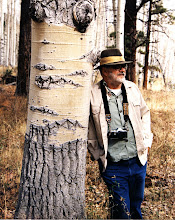
I have been wanting to take some decent photographs of quaking aspens in the snow for quite some time. I decided a few years ago that the only way this was going to happen was to go to Flagstaff when a snow storm is coming, hole up in Little America and sally forth from time to time to do some photography. Storms have come and gone over several years without me going to Flagstaff to be in one. I finally faced the facts, which are these: I hate being cold and wet and despise driving on snowy, icy roads. Therefore the chances of me deliberately going to Flag in the middle of a snowstorm are slim and none. So one day last week I rounded up an old white haired guy and went to Flag for the day. Below--Old White Haired Guy


The weather was beautiful;clear blue skies with an occasional white cloud, no wind, Phoenix temp 80+, Flagstaff temp 61. We drove from Flag to the west of Mt Humphries and north on the highway that leads to the South Rim of the Grand Canyon. We stopped at some aspen groves along the highway that had a turnout associated with them. Otherwise we couldn't stop the car along the highway because of the snow. We were at an elevation of 8000' plus, and there was plenty of snow, although it wasn't too cold. As seen below we were able to take advantage of a snowmobile track so we could walk in the snow without sinking in up to our butts.


The quakies in the snow are beautiful. Below are a couple of photos.


While walking along the snowmobile track we came to this magnificent old quakie. I don't know if this monarch of the forest is still alive, but I hope so. I plan on going back in late spring to see.


We stopped in Flag on the way home, had lunch,and took out a bank loan so we could buy enough gasoline to get home. While filling the Jeep with gas we noticed the cat below at the attached car wash cleaning the inside of his car. Apparently he exists in a portable anti-gravity bubble. I can think of no other explanation for his pants not being on the ground.


We drove on what I call the back way going and coming home. This road runs from Mesa through Payson, Pine and Strawberry and alongside Mormon Lake and Lake Mary. On the way home we saw a bunch of waterfowl in the shallow end of Lake Mary in an apparent feeding frenzy, probably after a school of fish, and a bald eagle flying close to them to see what was going on. No place to stop so no photos. I have traveled this road for at least 30 years and have never seen a bald eagle along it before. A fitting end to a great day.

Tuesday, March 1, 2011

Mesa Citrus: Going.....Going.......


When European settlers first got to the Mesa/Phoenix area they found a system of canals leading from the Salt River. The early settlers made use of these abandoned Hohokam Indian canals to attempt to get water from the Salt River to their crops. Below is a photo of an ancient Hohokam canal.

This water source was trouble because of drought and flooding. In 1902 the National Reclamation Act was passed. This act allowed for low cost loans from the Federal government for reclamation projects. The Salt River Valley Water Users' Association was formed in 1903. Members pledged some 200,000 acres of their own land as collateral and a loan was granted that resulted in the construction of Roosevelt Dam, at the junction of the Salt River and Tonto creek. The dam, the highest masonry dam ever built(280 feet), was completed in 1911. In 1996 it was encased in concrete and 77 feet added to the height, increasing its capacity by over 20%.Other dams were built later on the Salt and Verde river system and a series of canals built to carry water to the southern half of the Phoenix metropolitan area. As a result of these canals agriculture was much more successful. One of the crops planted to take advantage of the climate and this stable water source was citrus. Roosevelt Dam and a modern Salt River Project canal are shown below.


Approximately 80 years ago the citrus farmers formed an association, the Mesa Citrus Growers Association. They built a packing/shipping plant in central Mesa and shipped citrus from there under the Sunkist brand. They shipped up to one million boxes of fruit a year. In 1990 there were 45 growers who were members of the association. In June of 2010 their numbers had shrunk to 13; that spring after shipping 220,000 boxes they decided to close the plant. Below are some photos of the closed plant.


The man climbing up the fence is not homeless, but my photo buddy and son-in -law Matt Reed trying to get a better vantage point.

What happened? As I see it the biggest factor is the loss of citrus groves to housing. Most of the time a developer simply strips all the trees off and then builds houses.

Some of the upper end developments have left a row of trees around the edges made a gated community and given them uppity names like “The Groves”. A few have left the trees intact except to make roads and included irrigation water rights to the lots. We live in such an area. You can see the rows of citrus in our front yards in the photo below.


In our grove the citrus was planted in strips of type. Our lot had all navel orange trees; the house east of us has navels on the west half of the lot and Valencia or Arizona sweet oranges on the east half. A neighbor several houses east of us had all lemons. Our house was built in 1972 and some of the original trees have died. We have replaced them with navels, a grapefruit tree, a lemon tree, a lime tree and a tangerine.

There are still some commercial groves. They sell fruit locally through their own retail stores(see below) and some ship to Yuma or out of state for packing and distribution.


Below is a photo taken at a still functioning commercial grove.


Notice that the natural growth of the tree forms a skirt that goes virtually to the ground. This protects the trunk from sunburn. We suburbanites with citrus don't allow this skirt to develop so we can mow our lawns; thus the white painted trunks shown on our neighborhood trees to prevent sunburn. Two other items of interest in this picture: the tall fan and the square cut of the rows of trees. The fan stirs the air on cold nights to try and prevent frost damage. The trees are trimmed square by a frame with mechanical saws that fits over a row of trees and moves along the row trimming the trees to a uniform squareness. Makes picking and general care much easier.

One of the nice things about citrus is that you don't have to pick them all at once the minute they get ripe. Leave them on the tree—they last a long time. We start picking oranges in December and pick as needed until they are gone, usually some time in April. Real living is orange juice squeezed each day from oranges picked that morning. Our grapefruit season starts in February and runs until about August. The longer a grapefruit is on the tree the sweeter they get. Below are some of our home grown fresh picked citrus. Enjoy!

Monday, February 14, 2011

Fenestrations


For some reason or another which escapes me at the moment I have always found windows to be very interesting. As a result I have been photographing them for awhile. One of my friends says I have more windows than Andersen. I'm not sure about that but I have photographed quite a few. Some windows tell a story, such as hard times or elegance. Some are very colorful, some are truly marvelous. Some provide ventilation, some allow light to penetrate the interior of a building, some provide a view for the building occupants. Some examples are shown below.


The two windows shown above each tell a story of hard times with missing glass and weeds growing in the buildings. They are separated by thousands of miles, the one on the top is from Varna, Bulgaria and the one on the bottom from Miami, Arizona.

The window below reveals elegance and probably wealth on the part of the occupants. It is from Amsterdam.

The window below is in a shop on the Greek island of Santorini. I'm sure some stylish woman would find these attractive.

The window below is also from Thera, Santorini.

Some windows exist for no apparent reason except for decoration. Such is the one below found on a Victorian era house in St. Charles, Idaho.

The window below is one of my all time favorites. It is in the Alhambra in Grenada, Spain. The Alhambra as a whole is magnificent and this window is one of the many wonderful things there.

I am thinking about doing a book on windows. What do you think? Please vote in the poll. Thanks much for looking.

Wednesday, February 2, 2011

Riparian Reserve


The City of Gilbert, which is just to the south of Mesa, has done a very interesting and unique thing with their waste water. They decided they should use it to recharge the underground aquifer. They are doing this by having it percolate down to the aquifer from the surface. After it has been treated and is relatively clean, they put it in streams, shallow ponds and wetlands which they have created in a 110 acre plot of land. They have planted trees and other vegetation along the banks that you would find in riparian areas in the Sonoran desert. There are still a few natural riparian habitats in Arizona, but most of them have been damned and therefore turned into reservoirs or dry stream beds. They have placed fish in the ponds to eat weeds and insects. Some of the birds then eat the fish. There is one small lake where fishing by humans is allowed. There are some 3 miles of paths for walking, bicycling and horseback riding. There are benches and places to observe fauna, primarily birds. The photo above is a view of one of the ponds, with an egret on the far bank.

A red winged blackbird, seen below, welcomed us to his world.

Long billed dowitchers are common working the shallow waters for food, below.


There was a small flock of ring necked ducks the morning I was there, below.

Below is a photo of a great blue heron slowly walking across one of the ponds, stopping frequently. I presume he was hunting for breakfast.

Here is a photo of a great blue heron standing on top of a pole. I wonder if he is contemplating building a nest there.


The last photo is a cormorant. We watched him dive and return to the surface with this fish in his mouth. There was a problem, however. He was holding the fish in the middle, crosswise. In order to swallow it the fish needs to be lengthwise and go down head first. Any other way it will hang up because the fins need to go down flat, which they won't do if it goes tail first. So he tossed it in the air until he got it going right and then he swallowed it. Amazing to watch. The photo below is the flip where he gets it going head first. Serendipity at work allowing me to capture the action.


This is a great place for a morning walk. The only fly in the ointment is some fools have dropped cats off there which of course are now feral. The authorities are struggling with how to deal with this. I think a few red tail hawks and great horned owls would solve the problem.

Wednesday, January 26, 2011

The Pumpernickel Prince


I first met Larry Jung in med school at the U of Utah. Larry graduated in 1961, while I graduated in 1963. I believe he was an intern the year that, on the first weekend in June, three or four of my classmates and I skipped a couple of days of class and went to Yellowstone fishing. School lasted until almost July 1, but enough is enough. We invited a couple of house officers to join us and I think Larry was one of them. Our careers stayed two years apart for awhile. Larry went in the Army for two years after internship and then came back to the U for a residency in pediatrics. He finished residency just as I got out of the Army and began my residency at the U. I saw Larry one day just after starting residency, and he was wearing a very familiar bolo tie. In fact, it was mine! I asked him where he got it. He said he found it hanging in a house staff locker when he started residency. I said that it was mine, I had apparently left it there and would like it back, please and thank you. He said “finders keepers” and I obviously didn't appreciate it since I hadn't noticed it being missing for two years. As far as I know he had it until the end.

We both worked for a professor of peds at the U, I doing basic bench research and Larry doing more clinical things as a fellow. We collaborated on a study of packaging as a means of prevention of childhood poisoning due to medications. We turned it into an exhibit and Larry got to take it to various medical/scientific meetings. I didn't get to do any of these presentations because of the work load of the residency. It was bad enough under ordinary circumstances but because of the Vietnam war the residency was short staffed. We were both interested in newborns and the department agreed to send us to a neonatology meeting in January in Miami as a reward. It was a great meeting; we stayed with some friends of mine and had a great time. We found the meeting very stimulating and we managed to get in some snorkeling and a trip to the beach.

Larry liked to hunt and fish. One time during the house staff and fellowship days we went duck hunting on the Bear River in northern Utah. We used a flat bottomed, square nosed rowboat (which probably has some official name like a dingy or something but I have no idea what that might be). We left a car down stream where we wanted to get off the river, and put the boat in upstream quite a ways. It is legal to hunt ducks from a boat as long as you don't use a motor. We piled brush in the boat so it looked like a floating brush pile, got in and floated down the river. The ducks thought we were a pile of brush, which allowed us to get right in the middle of them. Then we would rise up, causing them to fly, and we would shoot. It was a great day; Larry, who was a taxidermist, mounted a duck for me from that trip.

We both liked country and western music. In those days there was some promoter who would put together a country and western concert about once a month. They were first held at the Old Mill at the mouth of one of the canyons in Salt Lake City and later at a theater in the round in Bountiful, a suburb of SLC. They had several performers at these, usually a mix of veterans and newcomers. We saw such old hands as Roy Acuff and some just starting out, such as Waylon Jennings. These concerts were a lot of fun. The old guys loved to entertain and didn't want to leave the stage. The new ones didn't know how to work an audience or show appreciation to the audience. Waylon was particularly bad that way. I never saw him live again, but I presume he got over it and learned how to deal with a live audience. But, I digress. Sorry about that.

Larry was much more of a big game hunter than I was. I only went mule deer hunting in Utah with him once or twice, and one time I had an elk tag. I went with him on a Wyoming antelope hunt, at a friend's ranch. After I moved back to Arizona he came down once to chase white tail deer with me in Southern Az. He introduced me to a member of his hunting group and we became fast friends. As a result I met all of the friend's family, including my wife. Best thing Larry ever did.

Neonatology was very much in its infancy. When Larry and I were starting our careers, you could literally count on one hand the number of genuine neonatologists in the United States. Larry did a fellowship with Dr. Lula Lubchenko in Denver, one of the few. I think it was for about 6 months. When he finished he came back to the U of U and started the first neonatal intensive care unit and the Intermountain Neonatal Progam which eventually resulted in neonatal and maternal transport and everything that goes along with high risk perinatal care. None of the things we take for granted today were available then—no transport incubators, no neonatal or infant ventilators, etc. Larry scrounged and jury rigged equipment to make do until manufacturers caught up.

The neonatology world was very small in those days. Larry had started his unit at the U and I had some extra neonatology training(not a full fellowship) and had a special care nursery at Cottonwood Hospital, a suburb of SLC. At that time Larry couldn't do much more than I could, but he had the advantage of house staff. I called him about a baby one day and he came out and we decided to transport it to the U. I know he used an ambulance with a Gurney and oxygen but I don't remember whether he used a fish bowl or what to deliver the oxygen and keep the baby warm. He said he was going to put the baby on a ventilator, which he was jury rigging. I remember saying “That's fine, Larry, but how are you gong to get him off the ventilator?” He said he didn't know but would cross that bridge when he came to it. This was the first baby Larry ventilated. Years later Dr. Belton Meyer, the first neonatologist in Arizona and a contemporary of Larry, and I were having a conversation about Larry. Belton said that Larry had him fly up to Utah to consult on the first baby Larry had put on a ventilator. The baby had been on the ventilator for 6 months and Larry needed help in getting him off. Belton was a bit surprised when I said that baby was originally my patient.

Larry was from the Chicago area; his father owned a bakery in Morton Grove where he baked and delivered a great deal of pumpernickel bread. Hence I sometimes referred to him as the “Pumpernickel Prince”. While I was in the Army I commanded a dispensary at Arlington Heights, not far from O'Hare.
One day during this time, Larry was flying in or out of O' Hare. Looking out the window he saw the Army facility at Arlington Heights and said to his wife “I wonder who's the poor bastard that's the doc down there?”

Larry had an endowed chair at the U of U named for him as well as the NICU at the U. He was truly a pioneer in neonatology and leaves a wonderful legacy. He was also an artist, sculptor and taxidermist.The photo below is of a premie newborn's hand sculpted by Larry. The sculpture is life size.

Most importantly, he was my friend. When I get to the other side, I expect him to have the river scouted and the boat piled with brush. He'll probably be wearing my bolo tie.